How Do You Start Posting on Threads Without Screaming Into the Void?
A practical guide to warming up your Threads account, finding your niche, using topics, and building a posting routine before expecting reach.

Starting a new account can feel weird.
You post something. Nothing happens.
No replies. No likes. No saves. No sign that anyone even saw it.
It feels like screaming into the void.
A lot of creators respond to that by posting harder. More hooks. More hot takes. More random ideas. More volume.
But if your account has no clear identity yet, posting more is not always the answer.
Sometimes the better first move is to warm up the account.
Not in a spammy growth hack way.
In a normal human way.
You need to show the platform and the people around your niche what your account is about.
Do not start by posting into empty space
A new or quiet account has very little context.
The platform may not have a strong idea of what you care about. Other people do not know what you usually talk about. Your profile may not have enough posts, replies, or interaction history to make your identity obvious.
That does not mean you are doomed.
It just means you should not expect every post to land immediately.
Before you publish aggressively, spend time becoming part of the conversations you want to be known for.
That means:
- follow people in your niche
- read what they post
- reply with useful thoughts
- save posts you actually care about
- repost or quote when you have something to add
- use topics that match your content
- repeat this every day for a few weeks
This gives your account a clearer shape.
You are no longer a random account posting random thoughts. You are starting to behave like someone who belongs inside a specific topic.
Threads is not only a Twitter clone
A common mistake is treating Threads exactly like X.
Yes, Threads is text based. Yes, it has fast public conversation. Yes, you can post short thoughts and replies.
But discovery on Threads is also heavily shaped by topics, communities, and interest based conversations.
That makes it feel less like pure broadcasting and more like joining a room.
If you only think of Threads as “post a take and wait for reach,” you miss the point.
A better question is:
Which conversation am I trying to enter?
That is why topics matter.
Threads lets people tag a topic on a post so others can discover posts associated with that topic in real time. Meta has also said posts with tagged topics generally receive more views than posts without one.
So if you are trying to grow, topics are not decoration.
They are placement.
Pick your niche before you post every day
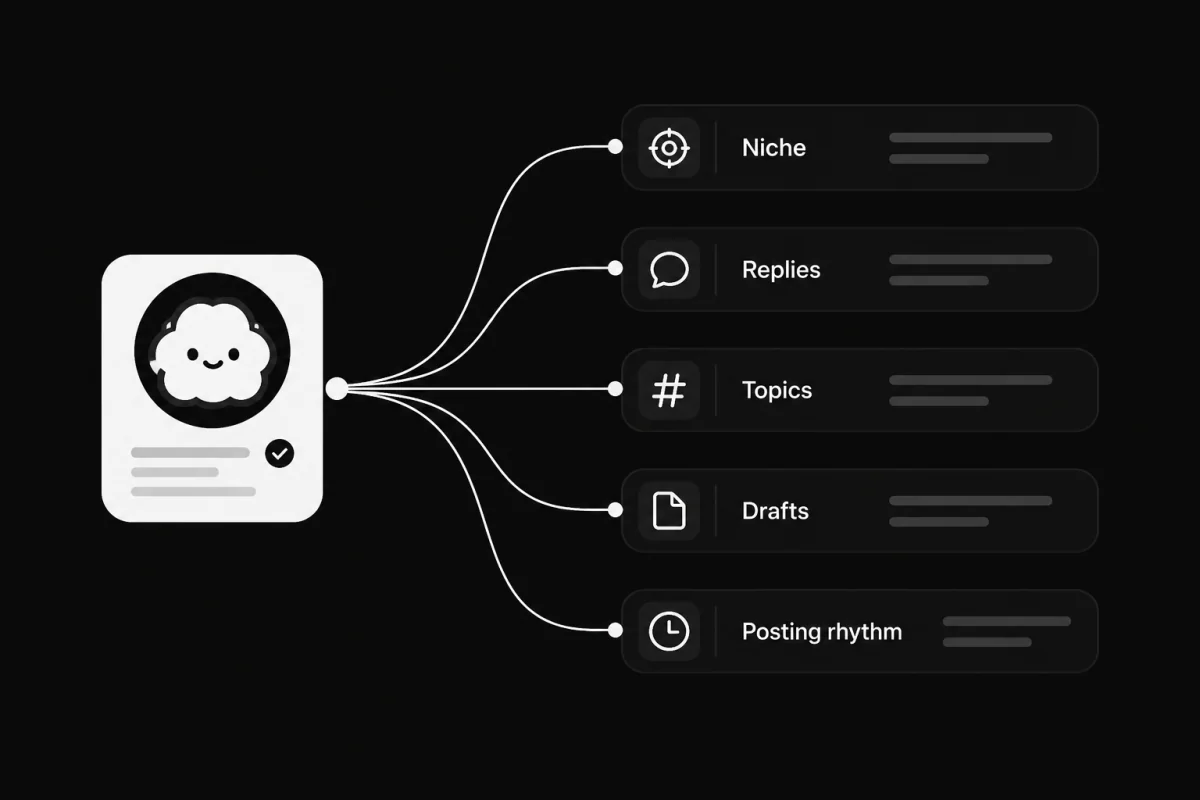
Before you worry about daily posting, decide what your account should be known for.
Not forever. Just for the next 30 days.
Pick 3 to 5 lanes.
For example, if you are a founder:
- building in public
- product decisions
- customer feedback
- pricing lessons
- distribution experiments
If you are a designer:
- UI critique
- visual taste
- product design
- portfolio breakdowns
- design tools
If you are a creator:
- content planning
- social media growth
- audience building
- monetization
- platform observations
These lanes make your account easier to understand.
They also make it easier to know who to follow, which posts to reply to, which topics to use, and what ideas to save.
Without lanes, every post becomes a separate guess.
With lanes, each post becomes part of a pattern.
Warm up your account for 2 to 3 weeks
You do not need a complicated strategy.
For 2 to 3 weeks, spend 1 to 2 hours a day inside your niche.
That sounds like a lot, but it does not have to be one long session.
You can break it into smaller blocks:
- 20 minutes reading posts
- 20 minutes replying
- 20 minutes saving ideas
- 20 minutes drafting your own posts
- 20 minutes reviewing what got engagement
The point is to build a habit of interaction before expecting distribution.
A simple warm up routine could look like this:
- follow 5 to 10 relevant accounts each day
- reply to 10 useful posts
- save or bookmark posts that match your topic
- write 2 to 3 rough post ideas
- publish 1 post around your core niche
- use one relevant topic when it fits
- avoid spamming the same comment everywhere
This is not a magic formula.
It is just a way to build signals and relationships.
You are teaching yourself what the niche talks about. You are showing people what you care about. You are giving your own posts a better chance to fit into the right context.
Reply like you want to be remembered
Replies are underrated.
A lot of people only think about original posts, but replies are often where new accounts get noticed first.
Good replies can show your taste faster than a cold post.
A weak reply says:
“Nice.”
A better reply adds:
- an example
- a useful disagreement
- a personal lesson
- a sharper question
- a missing detail
- a simple framework
If someone in your niche posts about content planning, do not just say “agree.”
Add something useful:
“I think the hardest part is not scheduling. It is capturing ideas before they disappear. A calendar only helps after the idea exists.”
That kind of reply gives people a reason to click your profile.
And when they do, your profile should make sense.
Save and bookmark posts on purpose
Saving posts is not just for later reading.
It also helps you build a personal idea library.
When you save posts inside your niche, you start seeing patterns:
- which hooks keep appearing
- which problems people repeat
- which topics get replies
- which opinions create discussion
- which questions people keep asking
Those saved posts can become raw material for your own content.
Do not copy them.
Study them.
Ask:
- why did this work?
- what angle did they use?
- what would I add?
- what do I disagree with?
- can I explain this from my own experience?
Growth gets easier when your content comes from real conversations instead of random brainstorming.
Use topics, but do not force them
Topics can help discovery, but only when they match the post.
Do not add a popular topic just because it is popular.
If your post is about creator workflow, use a topic around creators, content planning, or social media if it fits.
If your post is about SaaS, use a product building or startup related topic.
If your post is about design, use a design related topic.
The goal is to put your post where it belongs.
Bad topic use makes your account look confused.
Good topic use makes your account easier to understand.
Over time, you want people and the platform to associate your account with a few repeated ideas.
That is how you stop feeling random.
Do not worry about shadow ban too early
When posts get no reach, it is easy to assume something is wrong.
Maybe you think you are shadow banned. Maybe you think the platform is hiding you. Maybe you think the algorithm hates your account.
Sometimes platform issues happen.
But early on, low reach is often simpler than that.
Your account may not have enough context yet. Your posts may not be tied to a clear niche. You may not be interacting enough. Your topics may be inconsistent. Your profile may not tell people why they should follow.
Before blaming a shadow ban, check the basics:
- is your profile clear?
- are your topics consistent?
- are you replying inside your niche?
- are your posts connected to real conversations?
- are people responding when they do see your content?
- are you repeating what works?
If the answer is no, fix those first.
Shadow ban anxiety can become a distraction from the work that actually helps.
What to post during the warm up period
During the first 2 to 3 weeks, keep the posting simple.
You do not need perfect essays.
Post things that help people understand your lane.
Examples:
- a lesson you learned
- a mistake you made
- a question your niche cares about
- a simple framework
- a short opinion
- a reply expanded into a post
- a trend you noticed
- a before and after
- a tiny case study
You can use this daily pattern:
- one original post
- several useful replies
- one saved idea
- one draft for later
That is enough.
The goal is not to go viral immediately.
The goal is to build a base.
A simple 14 day warm up plan

Use this if you want something practical.
Day 1 to 3:
- choose 3 to 5 topics
- clean up your bio
- follow relevant accounts
- save posts you like
- reply lightly
Day 4 to 7:
- post once per day
- reply to 10 posts per day
- use relevant topics
- turn good replies into drafts
- notice which topics feel active
Day 8 to 14:
- repeat the topics that felt strongest
- write more original posts
- create small follow ups
- review what got replies
- schedule the best drafts ahead
After two weeks, you should have a clearer sense of:
- what you like talking about
- what your niche responds to
- which topics fit your account
- which posts feel worth repeating
- what kind of replies bring people to your profile
That is much better than posting randomly for two weeks and hoping something hits.
Build a posting system after the warm up
Once you have some signals, turn them into a system.
You do not need to manually reinvent your content every day.
Build a simple loop:
- capture ideas from your niche
- draft posts from replies and saved posts
- plan posts around your core topics
- schedule the best ones
- review which posts worked
- repeat the patterns that got real engagement
This is where most creators get stuck.
They can interact for a few days, but they do not have a place to turn that activity into planned content.
The ideas stay in bookmarks. The drafts stay in notes. The schedule lives somewhere else. The performance data is separate.
That makes consistency harder than it needs to be.
Map Out Your Ideas and Schedule with Katalisk
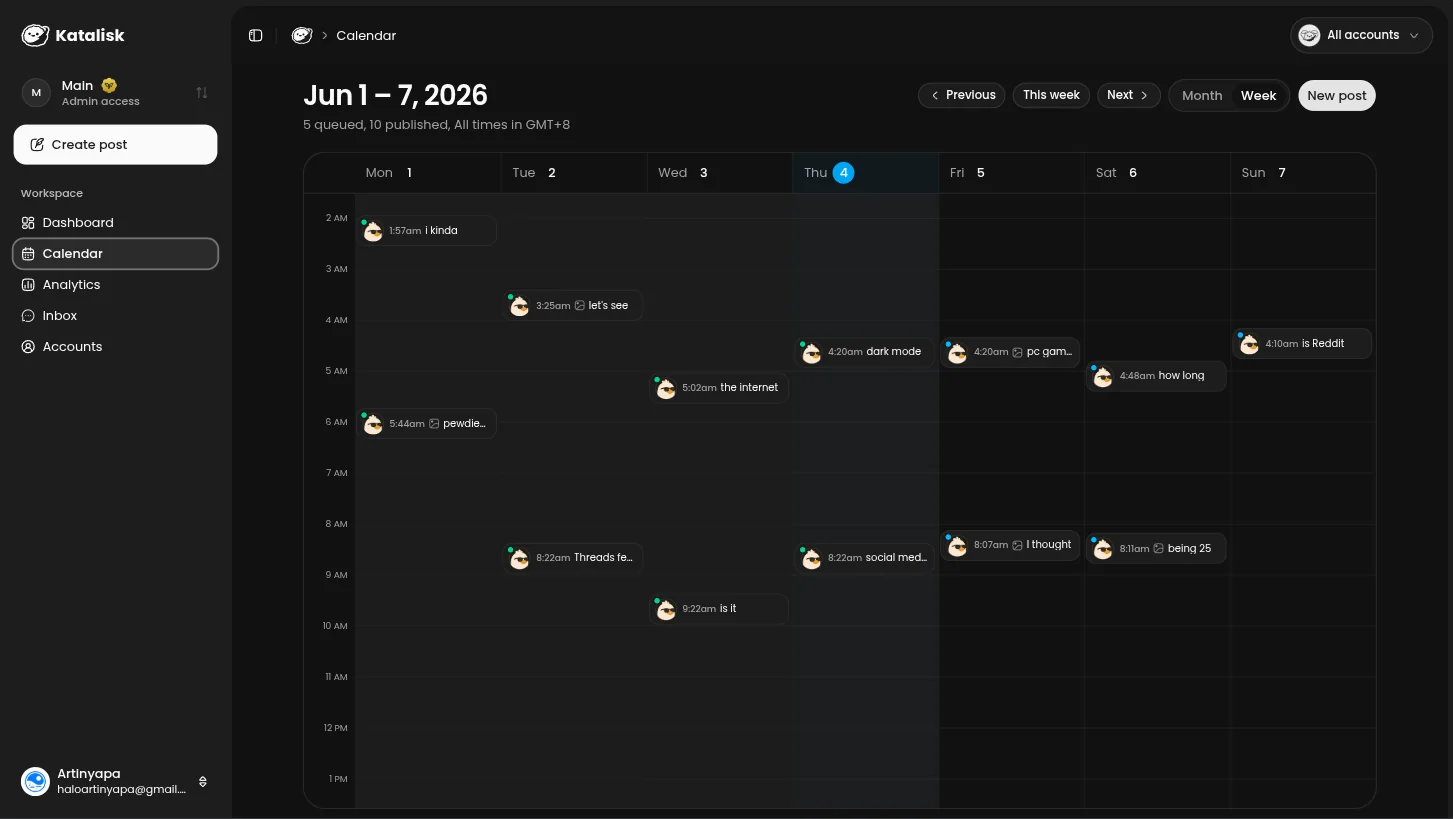
Katalisk is built for the part after the idea appears.
It gives creators one place to plan, schedule, and review content, starting with Threads.
You can use it to keep drafts organized, plan posts around your topics, manage connected accounts, and see what actually worked after publishing.
The goal is not to replace the human part of growth.
You still need to reply. You still need to understand your niche. You still need to develop taste.
Katalisk helps with the system around it.
So when your account starts warming up and ideas begin showing up, you have somewhere to put them.
Not scattered notes.
Not random tabs.
A cleaner workflow for turning attention into content.
Plan your next Threads post with Katalisk
Capture ideas, schedule posts, and review what worked in one clean creator workspace.