How Do You Grow on Threads Without Posting Randomly?
A practical guide to growing on Threads through consistency, topic focus, community participation, and a repeatable publishing workflow.

Growing on Threads is not only about posting more.
Posting more can help, but if the posts are random, disconnected, or aimed at no clear audience, it usually turns into noise.
A better question is:
How do you become recognizable around a topic?
That is where Threads gets interesting.
A lot of people still think of Threads as a direct competitor to X. In some ways, it is. It is text based, fast moving, and built around public conversation.
But the way people discover content on Threads feels different.
Threads is not only about broadcasting thoughts into a timeline. It also rewards being part of active conversations, posting around recognizable topics, and showing up in communities where people already care about what you are saying.
That makes Threads closer to a mix of X, Reddit, and Instagram discovery than a pure Twitter clone.
If you want to grow there, you need more than a posting habit. You need a publishing system.
Start with consistency, but do not confuse consistency with volume
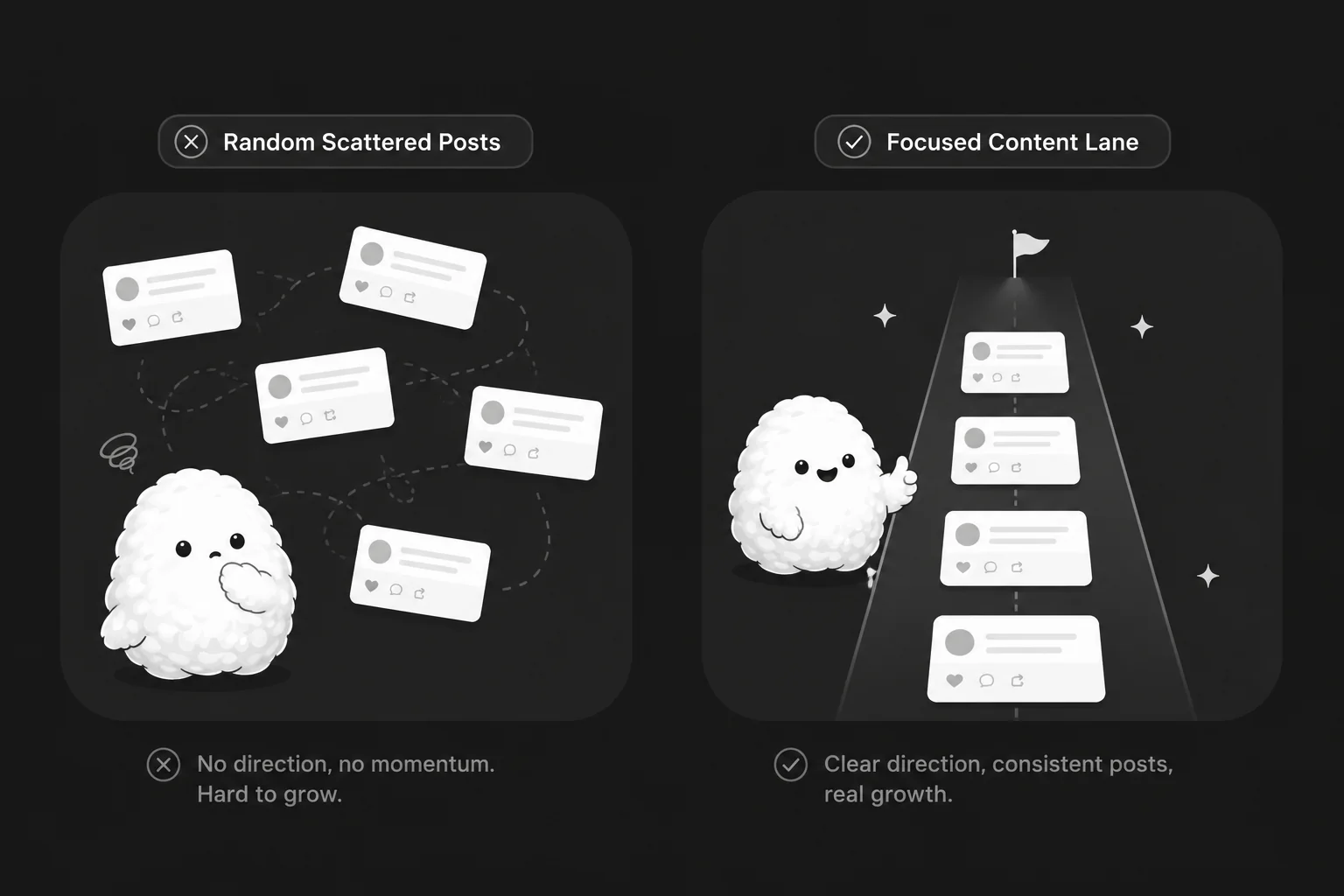
Consistency does not mean posting twenty times a day.
It means your account gives people a clear reason to remember you.
If someone sees your post once, they should understand what kind of person they just found. If they see five more posts from you, the pattern should become clearer.
That pattern can be about:
- the topics you talk about
- the problems you care about
- the kind of opinions you share
- the type of people you reply to
- the way you explain things
Consistency is about making your account easier to understand.
A random account makes people think:
"I liked this post, but I do not know what this person is about."
A consistent account makes people think:
"I want to see more from this person."
That is the difference.
Pick topics before you pick formats
A common mistake is starting with formats.
People ask:
- Should I post threads?
- Should I post short takes?
- Should I post questions?
- Should I post memes?
- Should I post screenshots?
Those things matter, but topic comes first.
On Threads, topic focus helps your content land in the right conversations. If you keep posting about completely unrelated things, the platform and the audience have less reason to connect your account with a specific interest.
A better approach is to choose a few content lanes.
For example, if you are building a SaaS product, your lanes could be:
- product building
- founder lessons
- design decisions
- marketing experiments
- small business operations
If you are a designer, your lanes could be:
- UI critique
- visual taste
- product design process
- portfolio breakdowns
- tools and workflow
If you are a creator, your lanes could be:
- content planning
- audience growth
- monetization
- personal lessons
- platform observations
The point is not to trap yourself.
The point is to make your account easier to place.
Use topics aggressively, but not lazily
Topics on Threads are not the same as stuffing hashtags everywhere.
You are not trying to decorate a post.
You are trying to place the post inside the right conversation.
If your post is about content planning, use the most relevant topic around content planning, creator growth, marketing, or whatever fits the actual post.
If your post is about product building, use the topic that matches the idea, not the most generic trending topic you can find.
Bad topic use looks like this:
- choosing a popular topic that barely matches the post
- changing topics every post with no strategy
- treating topics as a growth hack instead of a discovery signal
- writing for the topic instead of writing for people
Good topic use looks like this:
- choosing one topic that clearly matches the post
- repeating a few core topics over time
- joining conversations inside those topics
- learning which topics consistently bring better replies or views
If Threads is moving toward stronger topic and community discovery, creators should treat topics seriously.
Not as a trick.
As positioning.
Think more like Reddit than X
This is where Threads feels different from old Twitter habits.
On X, people often think in terms of hot takes, speed, and network effects. Who follows you matters a lot. Who quote posts you matters a lot. The timeline can reward being early, sharp, or controversial.
Threads can still reward that, but it also feels more interest based.
People gather around topics, communities, and recurring conversations. That makes it closer to Reddit in one important way:
Context matters.
A post that works in one community might feel irrelevant somewhere else.
A joke that lands with indie hackers might not land with designers.
A business lesson that works for founders might feel boring to casual readers.
So instead of asking:
"What should I post today?"
Ask:
"Which conversation am I entering?"
That shift changes how you write.
You start thinking about the room, not just the post.
Reply before you expect reach
If your account is new or quiet, do not only publish into empty space.
Reply.
Reply to people in your topic. Reply with useful thoughts. Add context. Disagree politely. Ask better questions. Share a small example from your own experience.
Replies help in two ways.
First, they put you inside active conversations.
Second, they help people understand your taste before they decide to follow you.
This is especially useful when you are warming up an account.
Warming up does not need to mean doing weird engagement tricks. It can simply mean acting like a real person before expecting the platform to treat you like a serious contributor.
A simple warm up routine could be:
- follow people in your niche
- reply to relevant posts every day
- post once or twice around your core topics
- avoid spammy repetition
- keep your account identity clear
That is not magic.
It is just making your account look and behave like it belongs in the conversation.
About shadow bans and low reach
A lot of creators worry about being shadow banned.
Sometimes low reach is caused by platform issues. Sometimes an account may be limited because of behavior that looks spammy. Sometimes content may not be distributed much because it is repetitive, low quality, or outside what your current audience responds to.
But most of the time, the more useful question is not:
"Am I shadow banned?"
The better question is:
"Have I given the platform and the audience enough clear signals?"
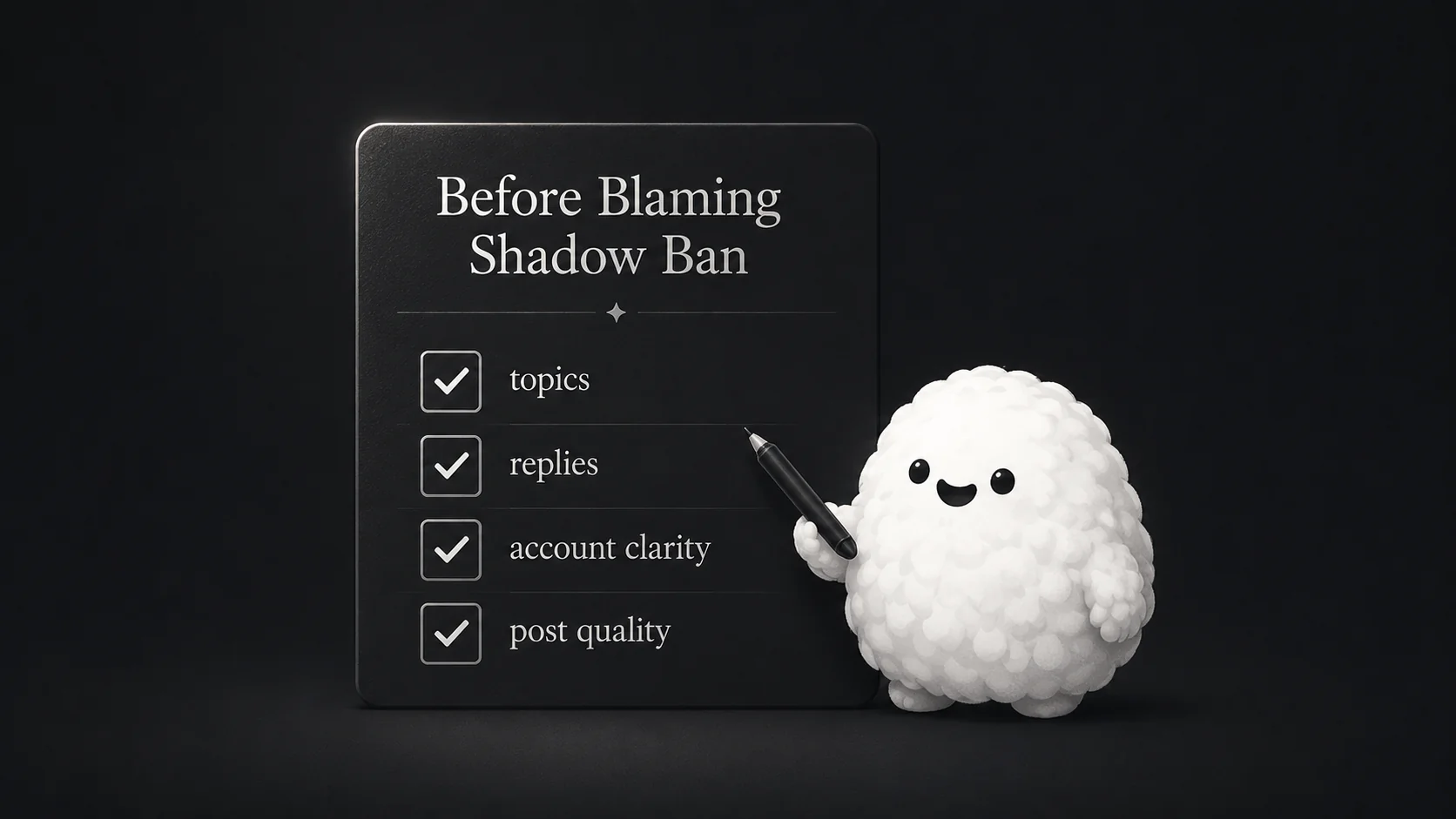
Those signals include:
- consistent topics
- real engagement
- clear account identity
- posts that invite replies
- content that fits active conversations
- enough time for patterns to form
If every post is about a different subject, if you never reply, if your account looks inactive, or if your content is only self promotion, low reach should not be surprising.
Before assuming shadow ban, audit the basics.
Are you posting around a clear topic?
Are you joining conversations?
Are people replying when they do see your posts?
Are you repeating formats that worked?
Are you learning from posts that failed?
That is usually a better place to start.
Do not only post original thoughts
A healthy Threads workflow should include more than original standalone posts.
You can grow through:
- original posts
- replies
- quote posts
- follow up posts
- topic based observations
- lessons from your own work
- responses to conversations already happening
Original posts are important, but replies and follow ups often create stronger relationships.
If a post performs well, do not just move on.
Turn it into a second post.
Add more context.
Share a mistake behind it.
Ask a sharper question.
Explain the opposite side.
A lot of creators waste good ideas because they treat every post as a one time event.
Good content can become a small series.
Use performance as feedback, not judgment
Analytics should not make you anxious.
They should make you sharper.
A post with low views might still be useful if it clarifies your thinking. A post with high views might not be useful if it brings the wrong audience. A post with few likes but strong replies might be more valuable than a post with shallow engagement.
When reviewing performance, look for patterns:
- which topics get replies?
- which formats get saved or shared?
- which posts bring followers?
- which ideas are worth repeating?
- which posts felt good but went nowhere?
- which posts performed better than expected?
The goal is not to become a slave to numbers.
The goal is to stop guessing.
If you are trying to grow, every post gives you some data. The mistake is publishing every day and never looking back.
Build a weekly Threads routine
Growth becomes easier when you stop treating content as a daily emergency.
A simple weekly routine could look like this:
- Monday: Plan the core topics for the week.
- Tuesday: Write drafts around those topics.
- Wednesday: Publish and reply inside relevant conversations.
- Thursday: Turn replies or good comments into new posts.
- Friday: Review what worked.
- Weekend: Capture ideas, screenshots, and observations for the next week.
This does not need to be rigid.
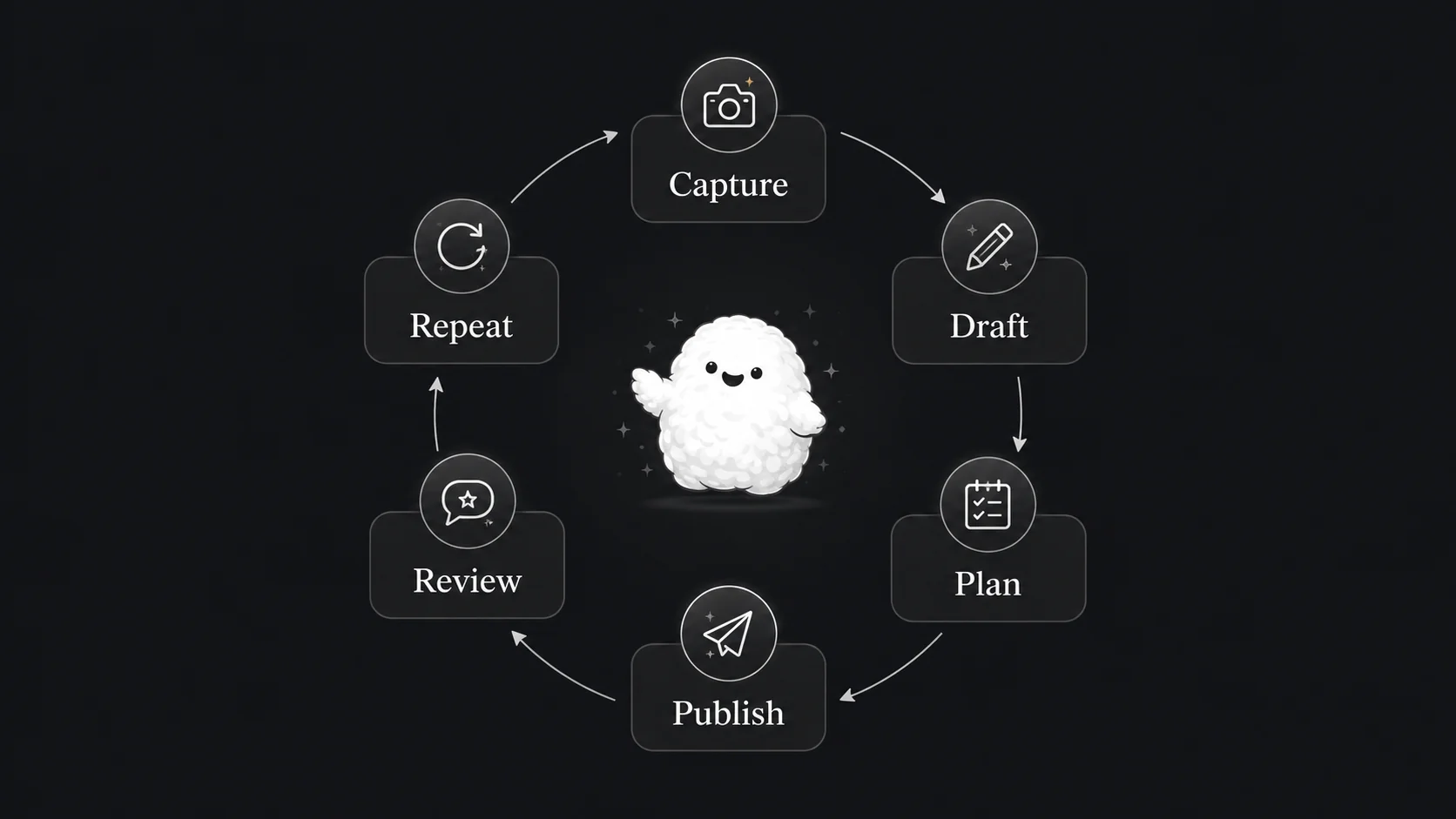
The point is to create a loop.
- Capture ideas.
- Draft them.
- Schedule or publish.
- Reply.
- Review.
- Repeat.
That is how consistency becomes manageable.
A simple Threads growth checklist
If you want a practical starting point, use this:
- choose 3 to 5 core topics
- write posts around those topics for at least 30 days
- reply daily inside those communities
- use relevant topic tags
- avoid posting only promotional content
- review posts weekly
- repeat what works
- turn strong replies into new posts
- keep a draft bank
- schedule ahead so you are not rushing every day
Growth is not only about one viral post.
It is about making the next post easier to write because the previous posts taught you something.
Where Katalisk fits
Katalisk is being built around this exact workflow.
Not just scheduling.
The goal is to help creators plan content, organize drafts, manage connected accounts, schedule posts, and review what actually worked.
Because growing on Threads is not only about showing up.
It is about building a system that helps you show up with context.
If you want to grow without posting randomly, you need a place for your ideas, your schedule, and your performance to live together.
That is what Katalisk is for.
Plan your next Threads post with Katalisk
Capture ideas, schedule posts, and review what worked in one clean creator workspace.